Law & Courts

Kentucky Religious School Asks U.S. Supreme Court to Block State Closure Order

By Mark Walsh — December 02, 2020 4 min read
The sun rises behind the U.S. Supreme Court in Washington on Nov. 10, 2020.
  • Save to favorites
  • Print

A Kentucky religious school has asked the U.S. Supreme Court for emergency relief from a state order that has closed all public and private K-12 schools in the state for in-person instruction amid the resurgence of the COVID-19 pandemic.

Danville Christian Academy, a 234-student pre-K-12 school in central Kentucky, is seeking to undo a ruling issued Sunday by a panel of the U.S. Court of Appeals for the 6th Circuit, in Cincinnati. The appellate court lifted an injunction that a federal district court had issued against Gov. Andrew G. Beshear’s Nov. 18 closure order.

The three-judge 6th Circuit panel ruled that Danville Christian’s claims of religious discrimination were unlikely to succeed on the merits because the governor’s order was neutral and generally applicable to all K-12 schools in the state.

The school, joined by Republican Attorney General Daniel Cameron, filed its emergency application on Dec. 1 with Justice Brett M. Kavanaugh, who is the circuit justice handling such matters for the 6th Circuit. Kavanaugh gave Beshear, a Democrat, until 4 p.m. Friday to respond.

Kavanaugh could rule on his own, but he is more likely to refer the application to the full Supreme Court. The court has dealt with multiple pandemic-related emergency orders since last spring. Last week, just before Thanksgiving, the justices ruled 5-4 to block New York Gov. Andrew M. Cuomo’s occupancy limits on church attendance in certain geographic zones with high COVID-19 positivity rates.

The ruling in Roman Catholic Diocese of Brooklyn, N.Y. v. Cuomo demonstrated the significance of new Justice Amy Coney Barrett’s replacement of Justice Ruth Bader Ginsburg. In the spring, the high court had declined relief from state limits to churches in California and Nevada. The vote in the California case was 5-4 with Ginsburg in the majority. But the high court has yet to address the issue of state orders closing schools.

There is one other pending emergency application on religious objections to state closure orders for houses of worship and schools. In Robinson v. Murphy (No. 20A95), a rabbi and a Roman Catholic priest are challenging New Jersey Gov. Philip D. Murphy’s capacity limits on houses of worship and mask mandate as it applies to religious services and schools. Murphy has a Thursday deadline to respond to the religious leaders’ application. (I described the New Jersey case in greater detail last week at the end of this story about the Brooklyn decision.)

The Kentucky application is Danville Christian Academy v. Beshear (No. 20A96). The school, which is represented by the First Liberty Institute, a Plano, Texas-based religious liberty organization, argues that schools have been targeted for closure while almost everything else in Kentucky is open except for bars and restaurants. Churches have remained open for in-person worship because of separate litigation, the filing notes, while college basketball at the University of Kentucky and University of Louisville played games to crowds of about 3,000 people each in recent days.

“To summarize, in Kentucky, one can catch a matinee at the movie theater, tour a distillery, work out at the gym, bet at a gambling parlor, shop, go to work, cheer on the Wildcats or the Cardinals, and attend a wedding,” the filing says, adding that day-care centers and colleges remain open, too.

“But all of Kentucky’s religious schools are shuttered,” the application states. It doesn’t dwell on the fact that public schools are closed to in-person instruction as well. Instead, the application is emphasizing the Supreme Court’s Diocese of Brooklyn decision, in which the majority was troubled by the stronger occupancy limits the New York order made on houses of worship than on many secular businesses.

For example, Danville Christian School’s filing says, Beshear’s order allows up to 25 people to attend weddings or movie theaters. But the school’s class sizes are all below 25 students.

“A neutral regulation of general applicability would treat all gatherings of 25 people in the same manner, regardless of why those 25 people are gathering indoors,” the filing says.

The school emphasized that it adopted multiple safety measures when it reopened for in-person instruction in August, including temperature checks, masks, and classroom dividers. Four students and one teacher have tested positive for COVID-19 since school opened, the filing said.

Under Beshear’s current order, public and private elementary schools may reopen for in-person instruction on Dec. 7 if certain local conditions are met. Middle and high schools will remain in remote learning until at least Jan. 4 under the order.

On Monday, Beshear issued a release saying there had been 4,151 new coronavirus cases and 35 deaths from the virus across the state on Dec. 1.

“There’s no way to sugarcoat it,” Beshear said in the release. “Today is the very worst day we have had for reporting on the spread of the coronavirus and it is the deadliest day that we have had.”
A version of this news article first appeared in The School Law Blog.

Events

This content is provided by our sponsor. It is not written by and does not necessarily reflect the views of Education Week's editorial staff.
Sponsor
School & District Management Webinar
Too Many Initiatives, Not Enough Alignment: A Change Management Playbook for Leaders
Learn how leadership teams can increase alignment and evaluate every program, practice, and purchase against a clear strategic plan.
Content provided by Otus
This content is provided by our sponsor. It is not written by and does not necessarily reflect the views of Education Week's editorial staff.
Sponsor
Artificial Intelligence Webinar
Beyond Teacher Tools: Exploring AI for Student Success
Teacher AI tools only show assigned work. See how TrekAi's student-facing approach reveals authentic learning needs and drives real success.
Content provided by TrekAi
This content is provided by our sponsor. It is not written by and does not necessarily reflect the views of Education Week's editorial staff.
Sponsor
College & Workforce Readiness Webinar
Building for the Future: Igniting Middle Schoolers’ Interest in Skilled Trades & Future-Ready Skills
Ignite middle schoolers’ interest in skilled trades with hands-on learning and real-world projects that build future-ready skills.
Content provided by Project Lead The Way

EdWeek Top School Jobs

Teacher Jobs
Search over ten thousand teaching jobs nationwide — elementary, middle, high school and more.
View Jobs
Principal Jobs
Find hundreds of jobs for principals, assistant principals, and other school leadership roles.
View Jobs
Administrator Jobs
Over a thousand district-level jobs: superintendents, directors, more.
View Jobs
Support Staff Jobs
Search thousands of jobs, from paraprofessionals to counselors and more.
View Jobs

Read Next

Law & Courts Supreme Court Backs Parents in School Gender Disclosure Fight
The Supreme Court restored an injunction blocking California policies on student gender transitions
8 min read
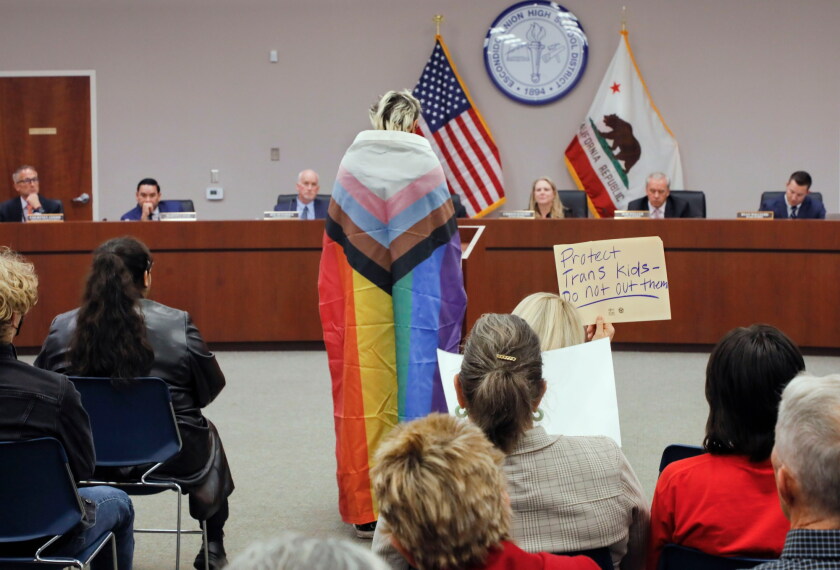
Teacher’s aide Amelia Mester, wrapped in a Pride flag, urges Escondido Union High School District not to have employees notify parents if they believe a student may be transgender in November 2025. A policy on the issue in the city’s elementary school district is the subject of a federal class-action lawsuit in which a judge just sided against the district.
Teacher’s aide Amelia Mester, wrapped in a Pride flag, urges Escondido Union High School District not to have employees notify parents if they believe a student may be transgender at a meeting in November 2025. Two parents and two teachers from the district sued in 2023, challenging California state guidance concerning student gender transitions and parental notification. The U.S. Supreme Court has now reinstated a lower-court decision overturning those state policies.
Charlie Neuman for The San Diego Union-Tribune/TNS
Law & Courts Appeals Court Allows Louisiana Ten Commandments Displays to Proceed
The court said it was premature to rule on the constitutionality of La. Ten Commandments displays.
3 min read
Students work under Ten Commandments and Bill of Rights posters on display in a classroom at Lehman High School in Kyle, Texas, Thursday, Oct. 16, 2025.
Students work under Ten Commandments and Bill of Rights posters on display in a classroom at Lehman High School in Kyle, Texas, Oct. 16, 2025. A federal appeals court has lifted a lower-court injunction blocking a Louisiana law that requires Ten Commandments displays, clearing the way for the law to take effect.
Eric Gay/AP
Law & Courts Social Media Companies Face Legal Reckoning Over Mental Health Harms to Children
Some of the biggest players from Meta to TikTok are getting a chance to make their case in courtrooms around the country.
6 min read
Social Media Kids Trial 26050035983057
Meta CEO Mark Zuckerberg leaves court after testifying in a landmark trial over whether social media platforms deliberately addict and harm children, on Feb. 18, 2026, in Los Angeles.
AP Photo/Damian Dovarganes
Law & Courts Supreme Court Strikes Trump Tariffs in Case Brought by Educational Toy Companies
Two educational toy companies were among the leading challengers to the president's tariff policies
3 min read
Members of the Supreme Court sit for a new group portrait following the addition of Associate Justice Ketanji Brown Jackson, at the Supreme Court building in Washington, Oct. 7, 2022. Bottom row, from left, Associate Justice Sonia Sotomayor, Associate Justice Clarence Thomas, Chief Justice of the United States John Roberts, Associate Justice Samuel Alito, and Associate Justice Elena Kagan. Top row, from left, Associate Justice Amy Coney Barrett, Associate Justice Neil Gorsuch, Associate Justice Brett Kavanaugh, and Associate Justice Ketanji Brown Jackson.
Members of the U.S. Supreme Court sit for a new group portrait following the addition of Justice Ketanji Brown Jackson, at the court building in Washington, Oct. 7, 2022. On Feb. 20, 2026, the court ruled 6-3 to strike down President Donald Trump's broad tariff policies, ruling that they were not authorized by the federal statute that he cited for them.
J. Scott Applewhite/AP
