Opinion
Policy & Politics Opinion

Why Do So Many Ed. Researchers Ignore Politics?

Yes, you can study politics without being a partisan hack
By Jon Valant — January 15, 2021 4 min read
Two figures argue over a a mountain of data
  • Save to favorites
  • Print

It’s a little puzzling that the research community doesn’t pay more attention to the politics of education. Schools are core public institutions, but political scientists haven’t shown much interest in education. Even the lure of rich data hasn’t attracted them like it has attracted other social scientists. And the education community, in turn, hasn’t shown much interest in politics, which are central to understanding the American educational system as it was, is, and could be.

That’s unfortunate. Pick just about any important question in education, and the answer involves politics. Why do we assign students to schools as we do? Why is Miguel Cardona poised to become the U.S. education secretary (and what can he do)? Why, again, do we pay teachers for master’s degrees? And why can’t we solve problems that we’ve understood for decades?

We need rigorous studies of these types of questions. The politics of education is complex, with unique webs of governing authority and stakeholders. Yet the politics of education seems relegated to the shadows of academic departments, scholarly journals, conferences, and funder portfolios.

See Also

Family observes a separate class room desk
J.R. Bee for Education Week
Families & the Community Opinion Three Urgent Questions the Pandemic Raises for Researchers
Michael McShane, January 15, 2021
4 min read

I don’t know why that is. Maybe it gets crowded out by the urgency of evaluating policies or classroom practices or maybe it’s just that there aren’t many senior researchers in the field to train junior researchers. Maybe, too, researchers tend to shy away from issues that feel overtly political.
Recently, I’ve waded into a few highly charged and partisan issues. That includes issues where the subject itself is political, like the politics of school reopening decisions. It also includes issues that aren’t about politics but have become politicized, like racial disparities in student discipline.

How can we, as researchers, inform debates about highly charged issues without becoming partisans ourselves? I struggle with that question myself. I have opinions about the issues I study and worry about the interplay between those opinions and my work.

How can we, as researchers, inform debates about highly charged issues without becoming partisans ourselves?

I do have a few guiding principles, though, that I try to keep in mind:

1. Recognize it isn’t inherently partisan to research many of the politicized issues in education. Take, for example, recent studies of how in-person schooling affected COVID-19 transmission. School reopening debates are about as politically charged as issues in education get, but a question about virus transmission lends itself to analysis that can inform debate without demanding that researchers take a side. Studies of topics such as mayoral control, school admissions priorities, and school board representation have illuminated messy political issues without drawing researchers into political battles they don’t want to fight.

2. Distinguish when you’re serving as an analyst from when you’re serving as an advocate. Each plays a different role with different responsibilities even if most researchers occupy these roles simultaneously. For me, the line runs between when I’m thinking about the ends, or goals, of education and when I’m thinking about the means to achieving those ends. How we see the goals of education reflects our principles and tends to have a partisan flavor (e.g., promoting equitable opportunities or individual liberty). I think it’s fine to advocate those ends, partly by looking for policies and practices that get us there. What isn’t fine is being so wedded to certain means of achieving those ends—like specific reforms, policies, or practices—that we are unwilling or unable to analyze them without personal bias. That undermines both our credibility and our ability to solve problems.
3. Be aware of how our political speech affects how people will read our analysis. Intentionally or not, many of us leave a clear impression of our political views on social media. Someone who criticizes or defends teachers’ unions on Twitter all day will have a hard time convincing anyone that a new study of how unions affect student outcomes is anything more than partisan fodder.

See Also

Researchers explore a data canyon
J. R. Bee for Education Week

4. Have a realistic understanding of how most people consume research, especially when it’s about a politically charged subject. Hardly anyone reads a full research paper or book chapter. In fact, depressingly few people get to the end of a blog post. Many want a one-sentence finding and, if possible, a figure that distills those findings in an image. If there’s critically important nuance, it needs to find its way into that sentence or figure (or, at minimum, an accompanying policy report explaining the findings). That’s especially true of research on touchy subjects, which tends to have different consumers, including more idealogues looking for ammunition.

The education research community often talks optimistically about the intersection of research, policy, and practice. The truth, though, is that the reality of evidence-informed policymaking seldom lives up to its promise. The reason is often politics. Politics sets boundaries on what’s possible and steers decisionmaking in ways that may or may not be desirable. It is essential that we don’t shy away from rigorously studying these dynamics, however fraught.

Related Tags:

A version of this article appeared in the January 20, 2021 edition of Education Week as Yes, You Can Study Politics Without Being a Partisan Hack

Events

This content is provided by our sponsor. It is not written by and does not necessarily reflect the views of Education Week's editorial staff.
Sponsor
School & District Management Webinar
Too Many Initiatives, Not Enough Alignment: A Change Management Playbook for Leaders
Learn how leadership teams can increase alignment and evaluate every program, practice, and purchase against a clear strategic plan.
Content provided by Otus
This content is provided by our sponsor. It is not written by and does not necessarily reflect the views of Education Week's editorial staff.
Sponsor
Artificial Intelligence Webinar
Beyond Teacher Tools: Exploring AI for Student Success
Teacher AI tools only show assigned work. See how TrekAi's student-facing approach reveals authentic learning needs and drives real success.
Content provided by TrekAi
This content is provided by our sponsor. It is not written by and does not necessarily reflect the views of Education Week's editorial staff.
Sponsor
College & Workforce Readiness Webinar
Building for the Future: Igniting Middle Schoolers’ Interest in Skilled Trades & Future-Ready Skills
Ignite middle schoolers’ interest in skilled trades with hands-on learning and real-world projects that build future-ready skills.
Content provided by Project Lead The Way

EdWeek Top School Jobs

Teacher Jobs
Search over ten thousand teaching jobs nationwide — elementary, middle, high school and more.
View Jobs
Principal Jobs
Find hundreds of jobs for principals, assistant principals, and other school leadership roles.
View Jobs
Administrator Jobs
Over a thousand district-level jobs: superintendents, directors, more.
View Jobs
Support Staff Jobs
Search thousands of jobs, from paraprofessionals to counselors and more.
View Jobs

Read Next

School Choice & Charters They Said No to the Federal School Choice Program. Now, 3 Dems Are Reconsidering
Advocacy to get Democratic states to participate has ramped up both locally and nationally.
4 min read
Democratic Oregon Gov. Tina Kotek speaks at a news conference in Portland, Ore., on Saturday, Sept. 27, 2025, after Republican President Donald Trump said he would send troops to the city.
Oregon Gov. Tina Kotek, a Democrat, speaks at a news conference in Portland, Ore., on Sept. 27, 2025. Kotek and three other Democratic governors initially said their states wouldn't participate in the first federal private school choice program. Now, three of those governors, including Kotek, are reconsidering their stances and say they haven't made up their minds.
Claire Rush/AP
Federal Opinion We Shouldn’t Have to Choose Between Federal Overreach and Abandonment in K-12
Why is federal power being used to occupy our cities but not protect our students’ civil rights?
Sally Iverson
4 min read
Large hand making pressure over group of small, silhouetted figures. Oppressions, manipulation. Contemporary art collage. Photocopy effect. Concept of world crisis, business, economy, control
Education Week + iStock
Law & Courts Supreme Court Backs Parents in School Gender Disclosure Fight
The Supreme Court restored an injunction blocking California policies on student gender transitions
8 min read
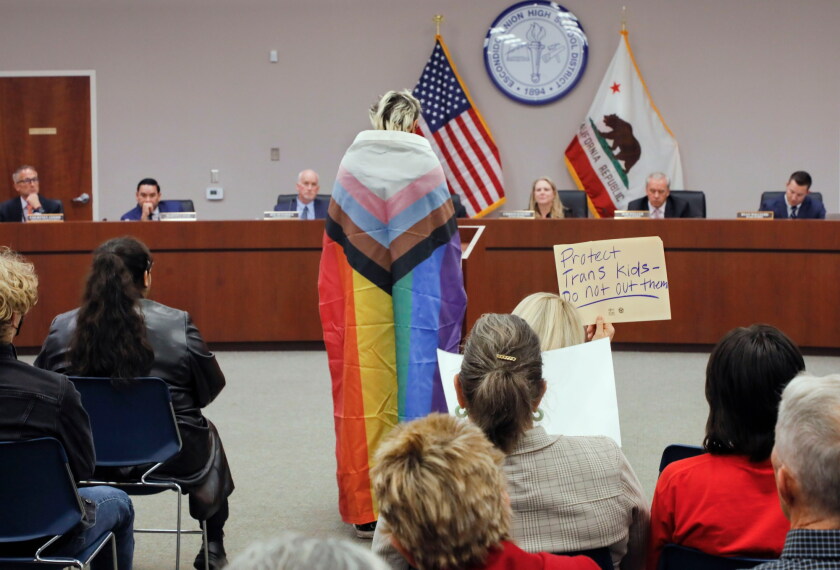
Teacher’s aide Amelia Mester, wrapped in a Pride flag, urges Escondido Union High School District not to have employees notify parents if they believe a student may be transgender in November 2025. A policy on the issue in the city’s elementary school district is the subject of a federal class-action lawsuit in which a judge just sided against the district.
Teacher’s aide Amelia Mester, wrapped in a Pride flag, urges Escondido Union High School District not to have employees notify parents if they believe a student may be transgender at a meeting in November 2025. Two parents and two teachers from the district sued in 2023, challenging California state guidance concerning student gender transitions and parental notification. The U.S. Supreme Court has now reinstated a lower-court decision overturning those state policies.
Charlie Neuman for The San Diego Union-Tribune/TNS
Federal Ed. Dept. Hangs Banner of Charlie Kirk Alongside MLK Jr., Ben Franklin
It's part of a celebration of the nation's 250th anniversary.
1 min read
New banners of Booker T. Washington, Catharine Beecher and Charlie Kirk hang from the Department of Education, Sunday, March 1, 2026, in Washington.
New banners of Booker T. Washington, Catharine Beecher, and Charlie Kirk hang from the U.S. Department of Education on March 1, 2026, in Washington.
Allison Robbert/AP