Law & Courts

Supreme Court to Decide Whether Nonlawyer Parents May Sue Under IDEA

By Andrew Trotter — October 27, 2006 2 min read
  • Save to favorites
  • Print

The U.S. Supreme Court today agreed to decide whether parents who are not lawyers have a right to represent their child with disabilities, or themselves, in federal court under the federal Individuals with Disabilities Education Act.

The Bush administration had urged the justices to take up the issue, on which various federal appeals courts had issued conflicting rulings in recent years.

The appeal stems from a lawsuit by Jeff and Sandee Winkelman, two Ohio parents who challenged the appropriateness of a school’s educational plan for their son, Jacob, who has autism spectrum disorder.

After several administrative hearings at which the parents represented their son, the Winkelmans sued the 13,000-student Parma school district in U.S District Court in Cleveland, challenging the hearing officers’ decisions that the district had provided their son a free, appropriate public education as required under the IDEA.

The district court ruled in favor of the school system in June 2005. The family appealed, but the U.S. Court of Appeals for the 6th Circuit, in Cincinnati, ruled last November that the parents could not proceed in that court without a lawyer.

The parents appealed to the Supreme Court, and in May the justices asked the Bush administration to weigh in on Winkelman v. Parma City School District (Case No. 05-983).

Parents’ Derivative Rights?

In a brief filed Sept. 20, U.S. Solicitor General Paul D. Clement suggested that the 6th circuit holding, barring parents from representing themselves under the IDEA, was “inconsistent with the plain language, structure, and purposes of IDEA.”

“Resolution of this conflict is warranted in view of the critical interests involved in IDEA litigation, the recurring nature of the question presented, and the need to ensure IDEA’s uniform application,” the brief said.

The Parma school district, in a brief opposing Supreme Court review, argued that the IDEA allows parents to represent their children in state administrative proceedings under the federal law, but not in federal court proceedings.

At stake, the district argued in its brief, is the quality of representation of the child, because “minor children with disabilities cannot make an informed choice to assume the risk of proceeding without counsel.”

The Supreme Court has not addressed whether parents are entitled to sue on their own behalf under the IDEA or whether their right to file an IDEA lawsuit derives from their child’s rights under the law, according to solicitor general’s brief.

The issue of whether the right is derivative is key, Mr. Clement argued, because a nonlawyer parent can only represent himself or herself and not the parent’s child.

While the 6th Circuit court held that nonlawyer parents may not press an IDEA case in federal court under any circumstance, another federal appeals court has ruled that nonlawyer parents are not limited at all. Four other appeals courts have held that such parents need a lawyer to press a child’s substantive claims under the IDEA, but not the parents’ procedural claims.

The court granted review of the case on Oct. 27, and it will likely hear arguments in the case sometime early next year.

Related Tags:

Events

This content is provided by our sponsor. It is not written by and does not necessarily reflect the views of Education Week's editorial staff.
Sponsor
School & District Management Webinar
Too Many Initiatives, Not Enough Alignment: A Change Management Playbook for Leaders
Learn how leadership teams can increase alignment and evaluate every program, practice, and purchase against a clear strategic plan.
Content provided by Otus
This content is provided by our sponsor. It is not written by and does not necessarily reflect the views of Education Week's editorial staff.
Sponsor
Artificial Intelligence Webinar
Beyond Teacher Tools: Exploring AI for Student Success
Teacher AI tools only show assigned work. See how TrekAi's student-facing approach reveals authentic learning needs and drives real success.
Content provided by TrekAi
This content is provided by our sponsor. It is not written by and does not necessarily reflect the views of Education Week's editorial staff.
Sponsor
College & Workforce Readiness Webinar
Building for the Future: Igniting Middle Schoolers’ Interest in Skilled Trades & Future-Ready Skills
Ignite middle schoolers’ interest in skilled trades with hands-on learning and real-world projects that build future-ready skills.
Content provided by Project Lead The Way

EdWeek Top School Jobs

Teacher Jobs
Search over ten thousand teaching jobs nationwide — elementary, middle, high school and more.
View Jobs
Principal Jobs
Find hundreds of jobs for principals, assistant principals, and other school leadership roles.
View Jobs
Administrator Jobs
Over a thousand district-level jobs: superintendents, directors, more.
View Jobs
Support Staff Jobs
Search thousands of jobs, from paraprofessionals to counselors and more.
View Jobs

Read Next

Law & Courts Supreme Court’s Gender Identity Ruling Leaves Schools Seeking Clarity
Advocates say they would welcome more from the Supreme Court on gender-notification policies.
7 min read
The Supreme Court is photographed, Friday, Feb. 27, 2026, in Washington.
The Supreme Court is photographed, Friday, Feb. 27, 2026, in Washington. The high court recently ruled that California policies that sometimes limit or discourage schools from disclosing information to parents about children’s gender transitions and expressions at school likely violate parents’ constitutional rights
Rahmat Gul/AP
Law & Courts Supreme Court Backs Parents in School Gender Disclosure Fight
The Supreme Court restored an injunction blocking California policies on student gender transitions
8 min read
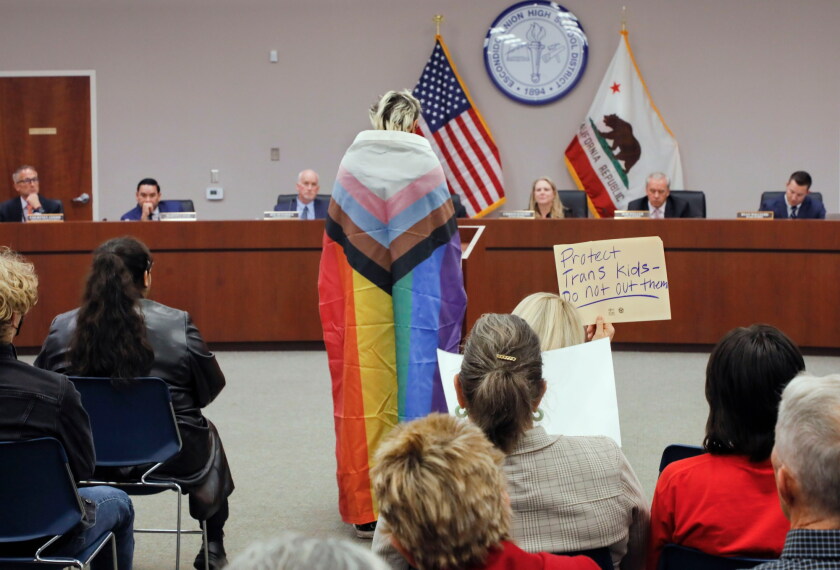
Teacher’s aide Amelia Mester, wrapped in a Pride flag, urges Escondido Union High School District not to have employees notify parents if they believe a student may be transgender in November 2025. A policy on the issue in the city’s elementary school district is the subject of a federal class-action lawsuit in which a judge just sided against the district.
Teacher’s aide Amelia Mester, wrapped in a Pride flag, urges Escondido Union High School District not to have employees notify parents if they believe a student may be transgender at a meeting in November 2025. Two parents and two teachers from the district sued in 2023, challenging California state guidance concerning student gender transitions and parental notification. The U.S. Supreme Court has now reinstated a lower-court decision overturning those state policies.
Charlie Neuman for The San Diego Union-Tribune/TNS
Law & Courts Appeals Court Allows Louisiana Ten Commandments Displays to Proceed
The court said it was premature to rule on the constitutionality of La. Ten Commandments displays.
3 min read
Students work under Ten Commandments and Bill of Rights posters on display in a classroom at Lehman High School in Kyle, Texas, Thursday, Oct. 16, 2025.
Students work under Ten Commandments and Bill of Rights posters on display in a classroom at Lehman High School in Kyle, Texas, Oct. 16, 2025. A federal appeals court has lifted a lower-court injunction blocking a Louisiana law that requires Ten Commandments displays, clearing the way for the law to take effect.
Eric Gay/AP
Law & Courts Social Media Companies Face Legal Reckoning Over Mental Health Harms to Children
Some of the biggest players from Meta to TikTok are getting a chance to make their case in courtrooms around the country.
6 min read
Social Media Kids Trial 26050035983057
Meta CEO Mark Zuckerberg leaves court after testifying in a landmark trial over whether social media platforms deliberately addict and harm children, on Feb. 18, 2026, in Los Angeles.
AP Photo/Damian Dovarganes
