
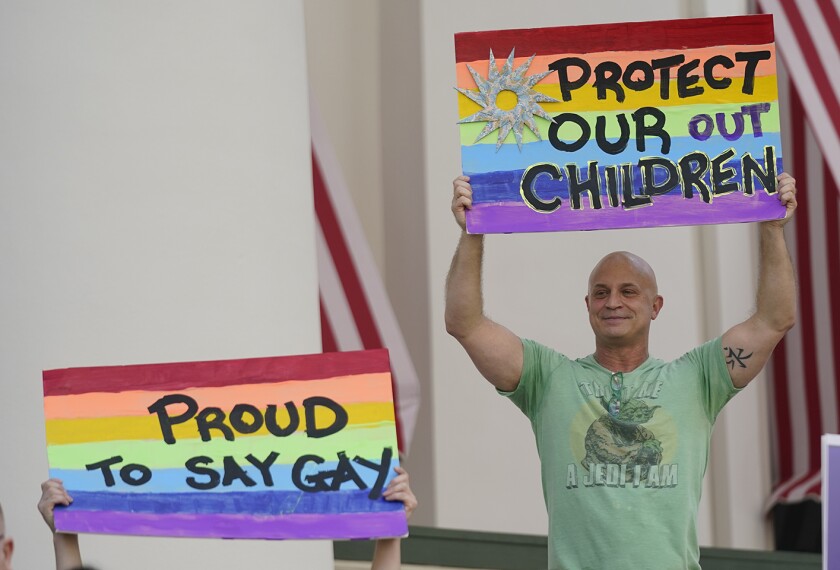
A federal version of Florida’s controversial “Don’t Say Gay” bill introduced last month would ban the use of federal resources to teach students about sexual activity and sexual orientation, gender identity, and dysphoria or transgenderism.
It’s highly unlikely that the bill, formally titled the “Stop the Sexualization of Children Act,” will be passed into law while Democrats control the House and Senate. But the Nov. 8 election results could offer Rep. Mike Johnson, the Louisiana Republican who proposed the bill, and his 33 co-signers, all Republicans, a chance at getting it passed.
“The Democratic Party and their cultural allies are on a misguided crusade to immerse young children in sexual imagery and radical gender ideology,” Johnson says in a statement. “This common-sense bill is straightforward. No federal tax dollars should go to any federal, state, or local government agencies, or private organizations that intentionally expose children under 10 years of age to sexually explicit material.”
But while Johnson called the bill “common-sense,” legal and LGBTQ advocacy experts say it’s concerning and a transparent political attempt at erasing LGBTQ identities.
“It’s quite important and deeply troubling that we saw these bills introduced,” said Jennifer Pizer, the chief legal officer at Lambda Legal, a civil rights organization focusing on defending the rights of LGBTQ people, “because it suggests that this issue is going to be the next anti-LGBTQ, right-wing bandwagon.”
The federal version follows a spate of anti-LGBTQ state legislation
This year, dozens of bills were introduced across the country that target LGBTQ students by restricting access to books about LGBTQ topics or lessons on sexual orientation and gender identity. Transgender students in particular have also been targeted in state legislation that attempts to restrict their use of restrooms aligned with their gender identity and limit theiraccess to team athletics, especially for trans girls.
Florida’s “Don’t Say Gay” law, officially known as the Parental Rights in Education law, is the most widely known example of that legislative genre and has inspired copycat bills across the country. Contrary to its nickname, though, that law did not specifically ban lessons on gender identity, sexual orientation, and transgender issues. Its critics dubbed it “Don’t Say Gay” because of its anti-LGBTQ intent, which was made evident by statements state lawmakers made when they were introducing the bill. For example, Gov. Ron DeSantis’ spokesperson, Christina Pushaw, called opponents of the bill “groomers” on Twitter, an accusation often aimed baselessly at LGBTQ rights advocates.
“Whether it’s this new bill introduced in Congress or the hundreds of bills that have been introduced in state legislatures around the country, it’s all the same,” said Aaron Ridings, chief of staff and deputy executive director for public policy and research at GLSEN, an LGBTQ advocacy organization.
“It’s about discrimination and exclusion, and that has extremely harmful impacts on young people’s long-term well-being and ability to achieve their full potential,” he said.
Bill language and enforcement
The federal bill outlaws any use of federal funds or facilities for “sexually oriented” education for children younger than 10 years old. Sexually oriented education is defined as any description or depiction of sexual activity and any topic including sexual orientation, gender identity, dysphoria, and transgenderism, according to the bill.
It also bans exposure of elementary students to “nude adults, individuals who are stripping, or lewd or lascivious dancing.”
“Many newly implemented sexual education curriculums encourage discussions of sexuality, sexual orientation, transgenderism, and gender ideology as early as kindergarten,” the bill says in citing the need for the proposed bans.
Its restrictions would also apply to public libraries that “target preadolescent children and teach them about concepts like masturbation, pornography, sexual acts, and gender transition,” and local government and private organizations that use federal money “to host and promote sexually oriented events like drag queen story hours and burlesque shows.”
The bill would also allow parents to file a civil lawsuit in federal district court against a government official, government agency, or private entity for violating the measure. It also says schools can’t receive federal money for three fiscal years if they receive two or more injunctions for violations.
“If this bill or a similar one were to pass at the federal level, that would be utterly appalling; it would be a throwback to prior generations, when information about LGBTQ people was widely censored,” Pizer said. “It would be scary and very harmful to young people in educational environments, to get the official message that there’s something wrong with them, there’s something wrong with their families.”


