
Federal

What the Federal ‘Don’t Say Gay’ Bill Actually Says

By Eesha Pendharkar — November 09, 2022 4 min read
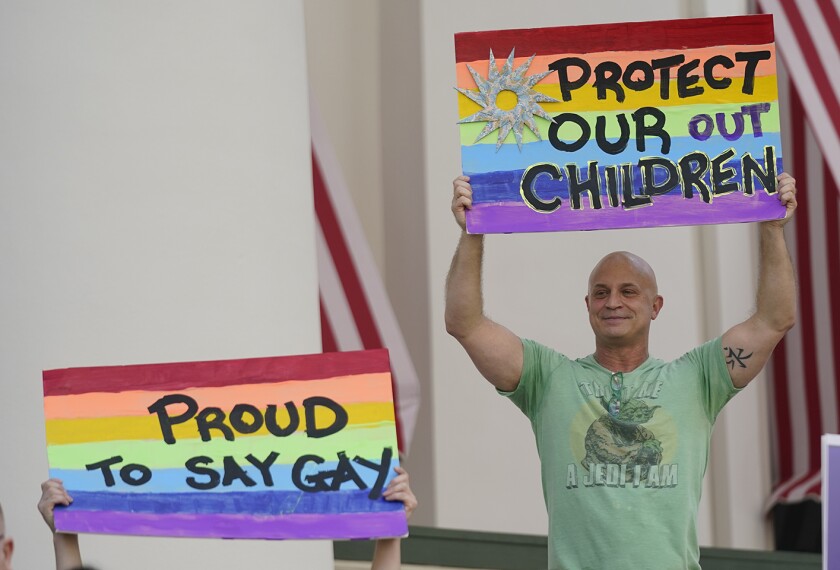
Demonstrators gather on the steps of the Florida Historic Capitol Museum in front of the Florida State Capitol on March 7, 2022, in Tallahassee, Fla. Florida House Republicans advanced a bill, dubbed by opponents as the "Don't Say Gay" bill, to forbid discussions of sexual orientation and gender identity in schools, rejecting criticism from Democrats who said the proposal demonizes LGBTQ people.
  • Save to favorites
  • Print

A federal version of Florida’s controversial “Don’t Say Gay” bill introduced last month would ban the use of federal resources to teach students about sexual activity and sexual orientation, gender identity, and dysphoria or transgenderism.

It’s highly unlikely that the bill, formally titled the “Stop the Sexualization of Children Act,” will be passed into law while Democrats control the House and Senate. But the Nov. 8 election results could offer Rep. Mike Johnson, the Louisiana Republican who proposed the bill, and his 33 co-signers, all Republicans, a chance at getting it passed.

“The Democratic Party and their cultural allies are on a misguided crusade to immerse young children in sexual imagery and radical gender ideology,” Johnson says in a statement. “This common-sense bill is straightforward. No federal tax dollars should go to any federal, state, or local government agencies, or private organizations that intentionally expose children under 10 years of age to sexually explicit material.”

But while Johnson called the bill “common-sense,” legal and LGBTQ advocacy experts say it’s concerning and a transparent political attempt at erasing LGBTQ identities.

“It’s quite important and deeply troubling that we saw these bills introduced,” said Jennifer Pizer, the chief legal officer at Lambda Legal, a civil rights organization focusing on defending the rights of LGBTQ people, “because it suggests that this issue is going to be the next anti-LGBTQ, right-wing bandwagon.”

The federal version follows a spate of anti-LGBTQ state legislation

This year, dozens of bills were introduced across the country that target LGBTQ students by restricting access to books about LGBTQ topics or lessons on sexual orientation and gender identity. Transgender students in particular have also been targeted in state legislation that attempts to restrict their use of restrooms aligned with their gender identity and limit theiraccess to team athletics, especially for trans girls.

Florida’s “Don’t Say Gay” law, officially known as the Parental Rights in Education law, is the most widely known example of that legislative genre and has inspired copycat bills across the country. Contrary to its nickname, though, that law did not specifically ban lessons on gender identity, sexual orientation, and transgender issues. Its critics dubbed it “Don’t Say Gay” because of its anti-LGBTQ intent, which was made evident by statements state lawmakers made when they were introducing the bill. For example, Gov. Ron DeSantis’ spokesperson, Christina Pushaw, called opponents of the bill “groomers” on Twitter, an accusation often aimed baselessly at LGBTQ rights advocates.

“Whether it’s this new bill introduced in Congress or the hundreds of bills that have been introduced in state legislatures around the country, it’s all the same,” said Aaron Ridings, chief of staff and deputy executive director for public policy and research at GLSEN, an LGBTQ advocacy organization.

“It’s about discrimination and exclusion, and that has extremely harmful impacts on young people’s long-term well-being and ability to achieve their full potential,” he said.

Bill language and enforcement

The federal bill outlaws any use of federal funds or facilities for “sexually oriented” education for children younger than 10 years old. Sexually oriented education is defined as any description or depiction of sexual activity and any topic including sexual orientation, gender identity, dysphoria, and transgenderism, according to the bill.

It also bans exposure of elementary students to “nude adults, individuals who are stripping, or lewd or lascivious dancing.”

“Many newly implemented sexual education curriculums encourage discussions of sexuality, sexual orientation, transgenderism, and gender ideology as early as kindergarten,” the bill says in citing the need for the proposed bans.

Its restrictions would also apply to public libraries that “target preadolescent children and teach them about concepts like masturbation, pornography, sexual acts, and gender transition,” and local government and private organizations that use federal money “to host and promote sexually oriented events like drag queen story hours and burlesque shows.”

The bill would also allow parents to file a civil lawsuit in federal district court against a government official, government agency, or private entity for violating the measure. It also says schools can’t receive federal money for three fiscal years if they receive two or more injunctions for violations.

“If this bill or a similar one were to pass at the federal level, that would be utterly appalling; it would be a throwback to prior generations, when information about LGBTQ people was widely censored,” Pizer said. “It would be scary and very harmful to young people in educational environments, to get the official message that there’s something wrong with them, there’s something wrong with their families.”

Events

This content is provided by our sponsor. It is not written by and does not necessarily reflect the views of Education Week's editorial staff.
Sponsor
School Climate & Safety Webinar
Belonging as a Leadership Strategy for Today’s Schools
Belonging isn’t a slogan—it’s a leadership strategy. Learn what research shows actually works to improve attendance, culture, and learning.
Content provided by Harmony Academy
This content is provided by our sponsor. It is not written by and does not necessarily reflect the views of Education Week's editorial staff.
Sponsor
School & District Management Webinar
Too Many Initiatives, Not Enough Alignment: A Change Management Playbook for Leaders
Learn how leadership teams can increase alignment and evaluate every program, practice, and purchase against a clear strategic plan.
Content provided by Otus
This content is provided by our sponsor. It is not written by and does not necessarily reflect the views of Education Week's editorial staff.
Sponsor
Artificial Intelligence Webinar
Beyond Teacher Tools: Exploring AI for Student Success
Teacher AI tools only show assigned work. See how TrekAi's student-facing approach reveals authentic learning needs and drives real success.
Content provided by TrekAi

EdWeek Top School Jobs

Teacher Jobs
Search over ten thousand teaching jobs nationwide — elementary, middle, high school and more.
View Jobs
Principal Jobs
Find hundreds of jobs for principals, assistant principals, and other school leadership roles.
View Jobs
Administrator Jobs
Over a thousand district-level jobs: superintendents, directors, more.
View Jobs
Support Staff Jobs
Search thousands of jobs, from paraprofessionals to counselors and more.
View Jobs

Read Next

Federal Will the Ed. Dept. Act on Recommendations to Overhaul Its Research Arm?
An adviser's report called for more coherence and sped-up research awards at the Institute of Education Sciences.
6 min read
The U.S. Department of Education building is pictured on Oct. 24, 2025, in Washington, D.C.
The U.S. Department of Education building in Washington is pictured on Oct. 24, 2025. A new report from a department adviser calls for major overhauls to the agency's research arm to facilitate timely research and easier-to-use guides for educators and state leaders.
Maansi Srivastava for Education Week
Federal Trump Talks Up AI in State of the Union, But Not Much Else About Education
The president didn't mention two of his cornerstone education policies from the past year.
4 min read
President Donald Trump enters to deliver the State of the Union address to a joint session of Congress in the House chamber at the U.S. Capitol in Washington, Tuesday, Feb. 24, 2026.
President Donald Trump enters to deliver the State of the Union address to a joint session of Congress in the House chamber at the U.S. Capitol in Washington, Tuesday, Feb. 24, 2026. The president devoted little time in the speech to discussing his education policies.
Kenny Holston/The New York Times via AP, Pool
Federal Education Department Will Send More of Its Programs to Other Agencies
Education grants for school safety, community schools, and family engagement will shift to Health and Human Services.
4 min read
Various school representatives and parent liaisons attend a family and community engagement think tank discussion at Lowery Conference Center on March 13, 2024 in Denver. One of the goals of the meeting was to discuss how schools can better integrate new students and families into the district. Denver Public Schools has six community hubs across the district that have serviced 3,000 new students since October 2023. Each community hub has different resources for families and students catering to what the community needs.
A program that helps state education departments and schools improve family engagement policies is among those the Trump administration will transfer from the U.S. Department of Education to the U.S. Department of Health and Human Services. In this photo, school representatives and parent liaisons attend a family and community engagement discussion on March 13, 2024, in Denver to discuss how schools can better integrate new students and families into the district.
Rebecca Slezak For Education Week
Federal New Trump Admin. Guidance Says Teachers Can Pray With Students
The president said the guidance for public schools would ensure "total protection" for school prayer.
3 min read
MADISON, AL - MARCH 29: Bob Jones High School football players touch the people near them during a prayer after morning workouts and before the rest of the school day on March 29, 2024, in Madison, AL. Head football coach Kelvis White and his brother follow in the footsteps of their father, who was also a football coach. As sports in the United States deals with polarization, Coach White and Bob Jones High School form a classic tale of team, unity, and brotherhood. (Photo by Jahi Chikwendiu/The Washington Post via Getty Images)
Football players at Bob Jones High School in Madison, Ala., pray after morning workouts before the rest of the school day on March 29, 2024. New guidance from the U.S. Department of Education says students and educators can pray at school, as long as the prayer isn't school-sponsored and disruptive to school and classroom activities, and students aren't coerced to participate.
Jahi Chikwendiu/Washington Post via Getty Images
