Teaching Profession The State of Teaching, 2024 Edition

‘You Don’t Know Teacher Tired': Educators Sound Off on Misconceptions

By Madeline Will, Elizabeth Heubeck, Ileana Najarro, Arianna Prothero & Sarah Schwartz — March 15, 2024 1 min read
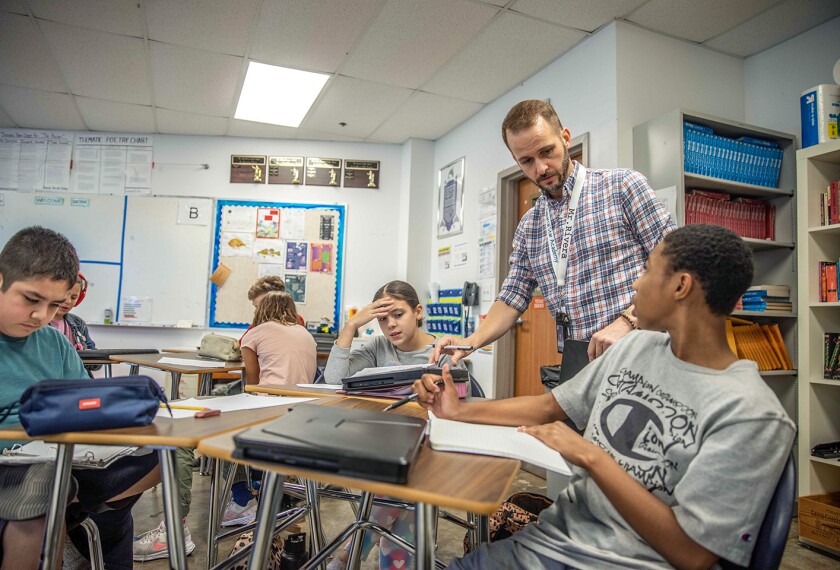
Frank Rivera teaches 7th grade ELA at Chaparral Star Academy in Austin, Texas, on Nov. 15, 2023.
  • Save to favorites
  • Print

The first-ever EdWeek Teacher Morale Index stands at -13, on a scale ranging from -100 to +100, with higher scores indicating more positive feelings about the profession.

The index, a multi-faceted measure of teacher satisfaction, is a central feature of Education Week’s new project, The State of Teaching. It gauges teachers’ levels of confidence and enthusiasm about their work based on responses to three survey questions that were part of a larger, nationally representative poll of nearly 1,500 teachers last October.

This year’s score suggests that on average, teachers are feeling more negatively than positively about their jobs. But why exactly is teacher morale so low?

sot visual stamp words only words only for inline promo

New national data on the teaching profession, vivid reporting from classrooms, and resources to help support this essential profession.

There are, of course, many reasons, including low salaries, heavy workloads, and a lack of support. The State of Teaching explored many of those themes.

To dig in a little deeper, Education Week reporters asked five teachers from across the country to share the hardest parts of teaching in recent years, as well as what they see as the biggest misconceptions about their jobs.

These answers have been edited for length and clarity.

What has been the hardest work-related challenge in the past two years?

   “This past year, I became a mom. [I pieced together a maternity leave with the limited days off I had accumulated as a new teacher, donated sick leave from other teachers, extra sick days paid at a reduced rate, and unpaid leave.] My maternity leave cost me $4,000.

“And then ... Oklahoma gave teachers six weeks [of paid maternity leave]. I was excited—and [missing that opportunity] was frustrating, to say the least. It has been financially a stressful year.

“Throw all of that in with just the learning curve that it is to become a parent, especially a mom. My son is still very much attached to me above anybody else. It made going back to work—for three weeks until the school year ended—bittersweet, because I was very much ready to go back to work, but I also wanted to be with my baby. I was stressed about leaving my baby.

“I invest a lot emotionally into my students—getting to know them very individually, getting to know their families. I’m now navigating having your patience bucket for your school life and then turning around to go home and do all that, too, [with my own child]. It’s challenging. But it’s worth it.”

—Sofia Alvarez-Briglie, a 7th grade science teacher at Alcott Middle School in Norman, Okla.

See also

Marianna Ruggerio, a physics teacher at Auburn High School in Rockford, Ill., is eight months pregnant with her second child. Her school district does not offer paid maternity leave, so she plans to use her sick days, then take unpaid leave.
Alyssa Schukar for Education Week

   Getting it all in. Time management. Curriculum requirements—managing that with classroom management.”

—Jacqueline Chaney, 2nd grade teacher at New Town Elementary in Owings Mills, Md.

   Not being able to provide my non-English-speaking students with an iPad in grades 3 to 5. I have two students, one in 3rd grade and one in 4th grade, for whom this is their second year for language acquisition. And they didn’t have any academic experience in their native language.

“Yes, they have a computer, they can use Google Translate. But with an iPad, they can take a picture [of a physical resource] and they can translate that text or the instructions given to perform a specific task. I believe that with that tool, it will ease their anxiety. It will make them more independent.”

—Griselle Rivera-Martinez, an English-for-speakers-of-other-languages teacher at Enterprise Elementary School in Enterprise, Fla.

See Also

Calendar posted on a bulletin board with sticky notes displaying emojis which become increasingly despondent as the month progresses
Vanessa Solis/Education Week vis Canva

   Last year, the biggest challenge was dealing with students that still hadn’t fully recovered from the COVID break—and it was a break, fundamentally, for a lot of kids.

“We had students that came to our school for the first time. [At our charter school, students attend half days in two cohorts so they can pursue other time-intensive pursuits.] ... We’re operating under the assumption that you can be in some way motivated and self-guided—to be able to do some of the necessary learning [on your own]. And sometimes these kids are so far behind that even approaching classroom subject matter is difficult for them, let alone in such a quick and vigorous environment.

“This year, I feel like there’s a politicization [brewing]. ... Up until this year, I’ve always felt like the political divide and the increasing stratification of the social environment hasn’t really made it onto our shores. But this year, we started to notice it and be a little bit concerned about it.”

—Frank Rivera, a middle and high school English/language arts teacher at Chaparral Star Academy in Austin, Texas

What is one thing the public misunderstands about the work of a teacher?

   I think because everyone has been at school, they feel like, ‘Oh, I was a student once before. Being a teacher is not that hard, because anyone can teach, right?’ They always say that quote, ‘Those who can, do; those who can't, teach.’ The big misconception is anyone can teach, anyone can be a teacher. It's not difficult to teach a child to learn. And I just don't think the public knows how much work and effort and heart we put into our jobs.”

—Helen Chan, a 4th grade math teacher at South Loop Elementary School in Chicago

   What I have heard out there is that teachers have all these days off. And I have heard from family members: ‘They do field trips. It’s so fun.’ They don’t know that it’s so stressful. You’ve got to make sure that all the kids get back to school, that they have to eat lunch.

“Even on days off, we’re still working. We’re working on those lesson plans. In my case, I might be talking to parents and helping [their children] with homework or whatever project that they need to finish. During the summer, we go to training.”

—Rivera-Martinez

See also

Jacqueline Chaney ask her 2nd graders a question during class at New Town Elementary School in Owings Mills, Md., on Oct. 25, 2023.
Jaclyn Borowski/Education Week

   You don’t know teacher tired until you are a teacher. You don’t realize all the things they do until you are a teacher. I feel that very strongly. During fall break, at a watch party for a football game at my house, the joke got made: ‘Oh, I wish my job gave me breaks.’ Everybody thought it was funny. I didn’t appreciate it. I didn’t think it was funny.

"Y’all can joke all you want, and your jobs are hard in their own respective ways, but you don’t understand how difficult my job is.”

—Alvarez-Briglie

   There’s a lot I think the public doesn’t understand. Parents are myopic in that they think that the teacher is there for their child. And that’s true partially, but I am also there for the classroom environment, and I’m there for the totality of learning that has to happen. And sometimes one child’s needs—and certainly parent wants—can’t come at the sacrifice of the full classroom learning environment. Not all parents, but there are some parents that think too much about what their child is experiencing and not how their child fits into the larger educational community.

“I also think that there’s this expectation that lesson planning and classroom discussion happens easily, and it does not. It requires a great deal of planning, a great deal of structure and a long time to manipulate and change. One item of discussion can dramatically impact what happens a week, two weeks, three weeks later, if you don’t present something in the right way when kids are ready to handle it.”

—Rivera

Related Tags:

Events

This content is provided by our sponsor. It is not written by and does not necessarily reflect the views of Education Week's editorial staff.
Sponsor
College & Workforce Readiness Webinar
Smarter Tools, Stronger Outcomes: Empowering CTE Educators With Future-Ready Solutions
Open doors to meaningful, hands-on careers with research-backed insights, ideas, and examples of successful CTE programs.
Content provided by Pearson
Recruitment & Retention Webinar EdRecruiter 2026 Survey Results: How School Districts are Finding and Keeping Talent
Discover the latest K-12 hiring trends from EdWeek’s nationwide survey of job seekers and district HR professionals.
This content is provided by our sponsor. It is not written by and does not necessarily reflect the views of Education Week's editorial staff.
Sponsor
Professional Development Webinar
Recalibrating PLCs for Student Growth in the New Year
Get advice from K-12 leaders on resetting your PLCs for spring by utilizing winter assessment data and aligning PLC work with MTSS cycles.
Content provided by Otus

EdWeek Top School Jobs

Teacher Jobs
Search over ten thousand teaching jobs nationwide — elementary, middle, high school and more.
View Jobs
Principal Jobs
Find hundreds of jobs for principals, assistant principals, and other school leadership roles.
View Jobs
Administrator Jobs
Over a thousand district-level jobs: superintendents, directors, more.
View Jobs
Support Staff Jobs
Search thousands of jobs, from paraprofessionals to counselors and more.
View Jobs

Read Next

Teaching Profession 'I Try to Really Push Through': Teachers Battle Sleep Deprivation
Many teachers say they get less than the recommended amount of sleep a night.
5 min read
Tired female teacher sitting alone at the desk in empty classroom, relaxing after class. Woman feeling stress, burnout and exhaustion in educational environment, working in elementary school.
Education Week and E+
Teaching Profession What the Research Says How Much Would It Cost States to Support Parental Leave for Teachers?
Two-thirds of states do not guarantee teachers parental leave, a new national study finds.
2 min read
As the teaching workforce increasingly skews younger, paying for educator's parental leave increases the financial pressure on districts.
LM Otero/AP
Teaching Profession Opinion The Three Worst Words You Can Say to a Teacher
I’m sick of hearing the same patronizing advice from administrators and professional development trainers.
3 min read
A person hunched over and out of energy with school supplies raining down.
iStock + Education Week
Teaching Profession Opinion For Teachers With the Novel-Writing ‘Bug,’ Authors Have Advice
How do I start to write a novel? How do I get it published? Look here for those answers and more.
11 min read
Conceptual illustration of classroom conversations and fragmented education elements coming together to form a cohesive picture of a book of classroom knowledge.
Sonia Pulido for Education Week