

There has been a big uptick recently in public discussion and media scrutiny of teens’ cellphone and social media use.
Today’s guest post features commentary on the topic from a teacher and her students.
‘Overly Simplistic’
Mary Beth Hertz teaches high school students art and technology in the Philadelphia school district, is a published author, and can be found at http://marybethhertz.me:
I have been discussing social media, digital habits, digital wellness, and navigating digital spaces with young people for well over a decade. It is some of my most fascinating and rewarding work. Most of that work has been with 9th graders in my Intro to Tech class that every 9th grader takes as part of their introduction to high school. The course is divided into three major units—Digital Literacy, Media Literacy, and Digital Citizenship. As part of the Media Literacy unit, we learn how to effectively use search terms, how to evaluate websites, gather information, summarize what we find, and come to our own conclusions.
I felt like I’d won the lottery this year. The topic I have students focus on for this work is “How has social media impacted teen mental health?” Right in the middle of the process, Jonathan Haidt released his controversial book, The Anxious Generation: How the Great Rewiring of Childhood Is Causing an Epidemic of Mental Illness.
I first learned of the book’s release through his interview on the Hidden Brain podcast. In the first part of the podcast, I was nodding along, but as the interview continued, I began to find some of his premises problematic and overly simplistic.
As his work exploded all over my social media feeds, I continued reading articles, and reviews, and listening to more of his interviews. I couldn’t help but notice that these were all missing a vital element—the voice of young people themselves. Yes, Haidt quotes research that involves surveys, and he refers to conversations he has had with teens, but the tone and cadence I get from these conversations exclude the complexity of young people’s digital lives and defer to finger-wagging and “bad, bad, bad.”
Yes, these distraction devices in the hands of young people whose brains are still developing are worrisome. For many, their phone becomes their crutch when things are hard or boring. They are often distracted by the tug of their social lives that now reside on their phones that give them instant access to their friends near and far. Yet, what I keep coming back to is that for many of my students, my class is the first place they have had space to dig into these conversations, explore their device use, and talk about how it makes them feel.
I decided to show my students the first 10 minutes of this interview with Haidt to see what they thought about his conclusions.
In response to the statement that kids have no hobbies anymore and that they don’t read anymore, my students shared:
“Yes but no, phones can take away from your productive time but it can replace it with other things that can be just as productive like reading articles online, watching documentary’s [sic], exercise videos, dance trends, etc.”
“I mostly agree with this statement, but it isn’t entirely caused by phones. From my experience, now there are fewer things for kids to do instead of using phones than in the past.”
On the topic of how boys are retreating from reality or social interactions:
“No I don’t because most boys go out and play sports”
“Many boys now are athletes.”
My students connected with the way that their phones can feel addicting and how much time people can spend on a screen instead of doing other things. What I found fascinating in our conversations was how Haidt’s definition of being social differed from their own. They didn’t feel that phones made them anti-social—their phones are a social tool—and they felt that their phones gave them access to their interests.
The conversation around athletics was interesting. I couldn’t help but wonder if the push for athletics was tied to the “overscheduling” aspect of parenting and the rising costs of college pushing more parents to look to sports scholarships as a window of opportunity for their children. In general, most students felt that there were kernels of truth to what Haidt was saying, but that, in the words of one student, “he’s being extremely dramatic.”
I keep coming back to the statement of a young college student on the Hard Fork podcast (the AI conversation starts around 26:30). She compares barring young people from using smartphones and social media to the struggles she sees her peers have when they have not had an opportunity to experiment with freedom before they arrive at college. In a nutshell, they suck at it and make really poor decisions. This is why I find the premise of Haidt’s work to be too simplistic. At some point, young people will have access to these tools, and we have a responsibility to prepare them for that. This is not as simple as removing access to their phones.
Don’t get me wrong: The research is clear that young people are struggling. It is clear that social media is having a huge impact on their lived experiences. It is also clear that a big shift is needed for screenless interactions and face-to-face communication and rebuilding resilience in our young people.
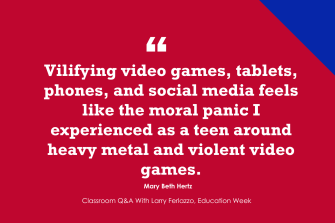
However, vilifying video games, tablets, phones, and social media feels like the moral panic I experienced as a teen around heavy metal and violent video games. It’s easier to point our fingers at the technology than look in the mirror and interrogate the deeper societal issues (gun violence, widening wealth gap, climate crisis, divisive politics …) that are also contributing to these phenomena.
In the interview we watched, Haidt makes a point to clearly state that these are not part of the equation, but to truly make a shift in young people’s lived experiences, we can’t ignore the world they are living in and inheriting. We should be asking: “How can we build a society with structures in place to support the safety and resilience of young people while also preparing them for a highly technological society that values the ability to communicate across many different modalities to solve the complex and existential issues we face?”
Consider contributing a question to be answered in a future post. You can send one to me at lferlazzo@epe.org. When you send it in, let me know if I can use your real name if it’s selected or if you’d prefer remaining anonymous and have a pseudonym in mind.
You can also contact me on Twitter at @Larryferlazzo.
Just a reminder; you can subscribe and receive updates from this blog via email. And if you missed any of the highlights from the first 12 years of this blog, you can see a categorized list here.


