
Artificial Intelligence From Our Research Center

Teachers Desperately Need AI Training. How Many Are Getting It?

By Lauraine Langreo — March 25, 2024 2 min read
Illustration of AI and classroom tools.
  • Save to favorites
  • Print

Even though it’s been more than a year since ChatGPT made a big splash in the K-12 world, many teachers say they are still not receiving any training on using artificial intelligence tools in the classroom.

More than 7 in 10 teachers said they haven’t received any professional development on using AI in the classroom, according to a nationally representative EdWeek Research Center survey of 953 educators, including 553 teachers, conducted between Jan. 31 and March 4.

The survey data shows that teachers who are in urban districts, those in districts with free/reduced-price meal rates of more than 75 percent, and those who teach elementary grades are more likely than their peers to say they haven’t received any AI training.

A previous EdWeek Research Center survey found that one of the major reasons teachers aren’t using AI in their work is because of a lack of knowledge and support for how to use AI tools effectively and appropriately.

Some experts say that educators can’t ignore this technology that is predicted to be a huge force in the world. They say that it’s important for teachers to learn more about AI, not just so they can use it responsibly in their work, but also to help model that use for students who are already interacting with this technology and will need to become smart AI consumers.

Districts have ‘competing priorities’

For Justin Sealand, a math teacher for Woodford County High School in Versailles, Ky., getting training on AI is important because “the kids are going to be looking for” it, and “I would personally like to be able to provide that.”

While his district has provided two professional learning sessions focused on AI so far, Sealand still wants more training.
See Also

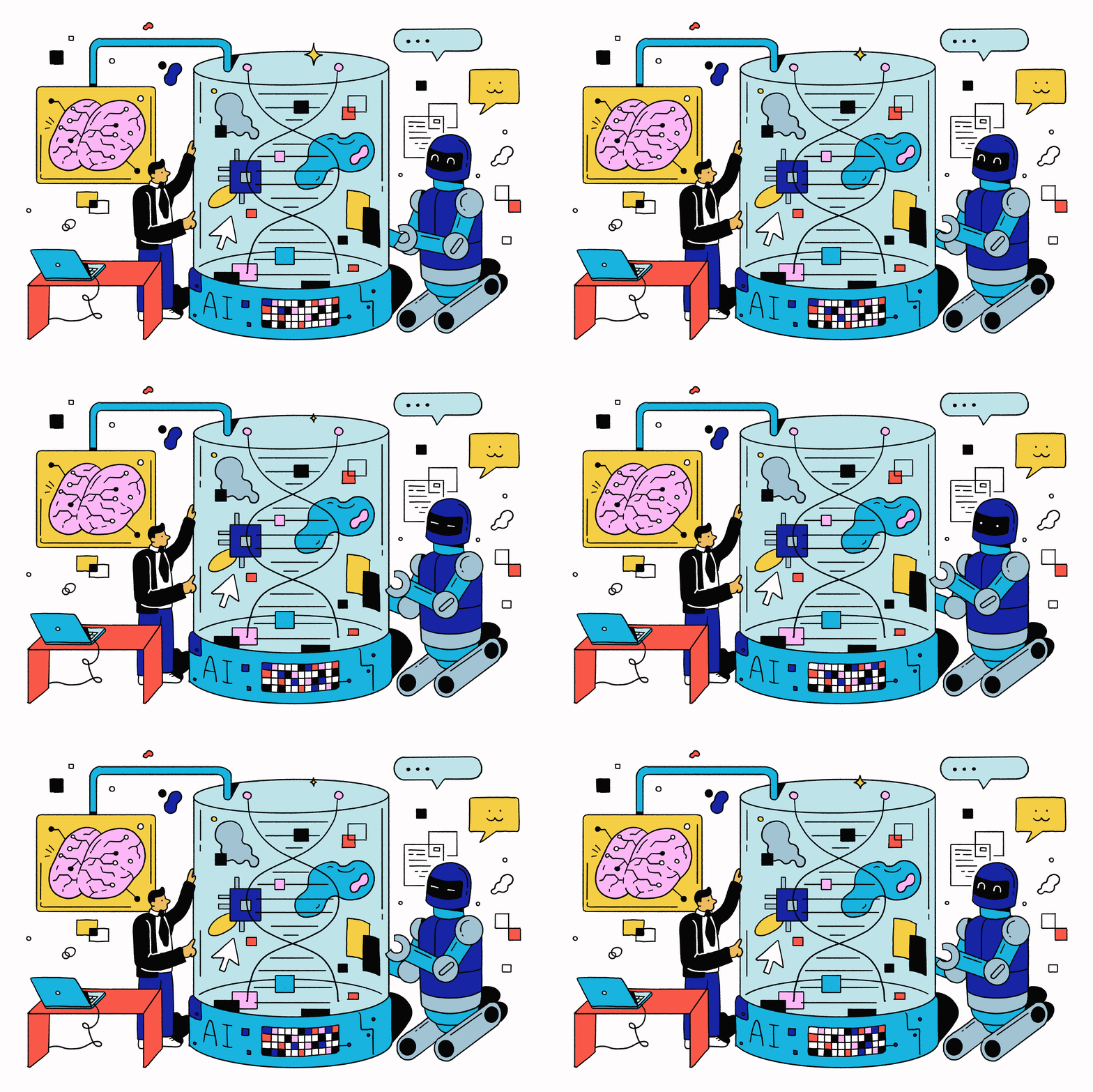
A person and a robot study a giant cylinder filled with AI elements
Kathleen Fu for Education Week

“I want it to be way more tailored to what I’m trying to accomplish,” he said.

For instance, for his class, he writes a lot of code for graphics or manipulatives and curates datasets for statistics examples, but he would like to “figure out how to better leverage AI for those content-specific things.”

But it’s not surprising that many districts have yet to provide AI-specific training, said Tara Nattrass, the managing director of innovation strategy at the International Society for Technology in Education and the Association for Supervision and Curriculum Development.

“Districts are focusing on a lot of different areas right now,” Nattrass said. “There’s a focus on the science of reading. There’s a focus on social-emotional learning. There are a lot of competing priorities when we look across school districts, and AI is one piece of that.”

Looking for PD opportunities elsewhere

Sealand said he understands why his district hasn’t had any other training on AI beyond the basics.

“I might be the only person in my entire district interested in that hyper-specific type of prompt writing,” he said. So in his own time, he’s been researching ways to leverage AI tools to create graphics, visualizations, and manipulatives to use for demonstrations with his students.

See Also

Photo collage of computer with pixelated image of girl.
F. Sheehan for Education Week / Getty

Other educators are also looking for professional development opportunities outside of the district. More than 3,500 educators have signed up for ISTE’s professional learning course on AI, according to the organization. Others are also participating in the organization’s webinar sessions on AI, Nattrass said.

This isn’t a bad thing, according to Nattrass. Teachers should have “a variety of ways” to engage in AI learning, such as district-led professional development opportunities, courses from other organizations, and networking with other educators.
Related Tags:

Events

This content is provided by our sponsor. It is not written by and does not necessarily reflect the views of Education Week's editorial staff.
Sponsor
College & Workforce Readiness Webinar
Smarter Tools, Stronger Outcomes: Empowering CTE Educators With Future-Ready Solutions
Open doors to meaningful, hands-on careers with research-backed insights, ideas, and examples of successful CTE programs.
Content provided by Pearson
This content is provided by our sponsor. It is not written by and does not necessarily reflect the views of Education Week's editorial staff.
Sponsor
Reading & Literacy Webinar
Improve Reading Comprehension: Three Tools for Working Memory Challenges
Discover three working memory workarounds to help your students improve reading comprehension and empower them on their reading journey.
Content provided by Solution Tree
Recruitment & Retention Webinar EdRecruiter 2026 Survey Results: How School Districts are Finding and Keeping Talent
Discover the latest K-12 hiring trends from EdWeek’s nationwide survey of job seekers and district HR professionals.

EdWeek Top School Jobs

Teacher Jobs
Search over ten thousand teaching jobs nationwide — elementary, middle, high school and more.
View Jobs
Principal Jobs
Find hundreds of jobs for principals, assistant principals, and other school leadership roles.
View Jobs
Administrator Jobs
Over a thousand district-level jobs: superintendents, directors, more.
View Jobs
Support Staff Jobs
Search thousands of jobs, from paraprofessionals to counselors and more.
View Jobs

Read Next

Artificial Intelligence From Our Research Center More Teachers Are Using AI in Their Classrooms. Here's Why
But there's still a big number of teachers who don't plan to use the technology.
3 min read
Teacher and kids using tablets and artificial intelligence in school classroom; a.i. assisted lessons.
iStock/Getty and Education Week
Artificial Intelligence Video Is the ‘AI Glow’ Starting to Wear Off? What to Expect in 2026
Artificial intelligence is now integrated into a wide variety of products and services that K-12 schools use, making it almost inescapable.
1 min read
English teacher Casey Cuny reads in his classroom as a screen displays guidelines for using artificial intelligence at Valencia High School in Santa Clarita, Calif., on Aug. 27, 2025.
Jae C. Hong/AP
Artificial Intelligence Quiz Quiz Yourself: How Is AI Reshaping K-12 Career and Technical Education?
Test your knowledge on AI trends in students' careers.
1 min read
Students in Bentonville public schools’ Ignite program work on projects during class on Nov. 5, 2025, in Bentonville, Ark. The program offer career-pathway training for juniors and seniors in the district.
Students in the Bentonville public schools' Ignite program work on projects during class on Nov. 5, 2025, in Bentonville, Ark. The program offer career-pathway training for juniors and seniors in the district.
Wesley Hitt for Education Week
Artificial Intelligence The Rise of Deepfake Cyberbullying Poses a Growing Problem for Schools
The fallout from the spread of the manipulated photos and videos can create a nightmare for the victims.
4 min read
122225 education deepfakes AP BS
A school bus carries children at the end of a school day at Sixth Ward Middle School in Thibodaux, La., on Dec, 11, 2025. When a middle school student in Louisiana got into a fight with classmates who were sharing Al-generated nude images of her, she ended up getting expelled.
AP
