

Are tiny screens any less disruptive than bigger ones?
Some schools aren’t waiting around to find out: A small but growing number have already crafted and adopted policies on the use of smartwatches in their schools. Schools are restricting or banning the use of these wearable devices during instructional time, or only allowing them during recess and lunch, akin to cellphones.
Smartwatches aren’t as ubiquitous as smartphones—yet. While 95 percent of adolescents aged 13-17 had access to a cellphone, only 13 percent of teens owned smartwatches, according to a 2021 study by the Pew Research Center.
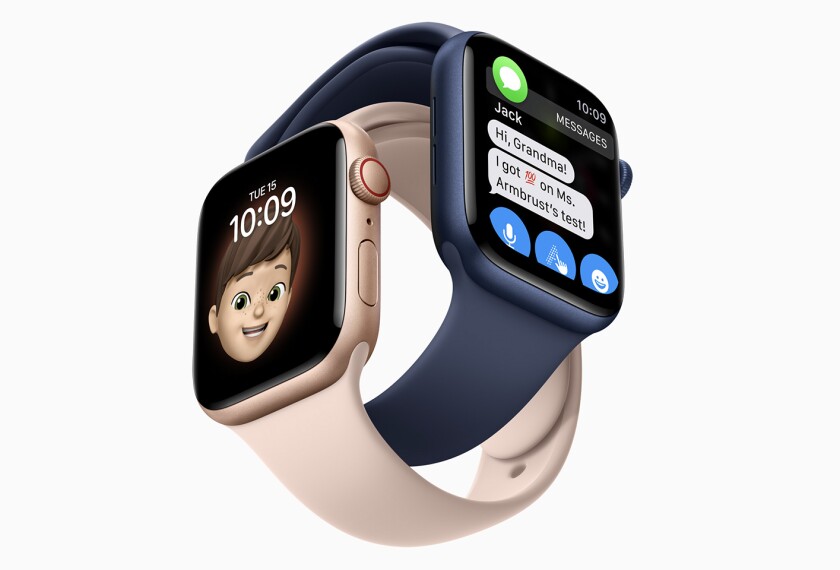
Smartwatches don’t provide quite the same user experience as a smartphone, owing to their smaller screens. Students can, nonetheless, do almost everything they do on a smartphone—text each other, use apps, get on websites, and scroll through social media. Parents can also stay digitally connected to their children through location-sharing features.
In a nationally representative survey conducted by the EdWeek Research Center over the summer, 11 percent of school and district leaders reported a complete ban on smartwatches in their schools. The most common answer, though—34 percent—was that their use is permissible under specific conditions.
Almost 30 percent of educators said their school or district doesn’t currently have a smartwatch policy but is considering adding one.
Forty percent of teachers, principals, and district leaders thought smartwatches pose a behavioral or disciplinary challenge, while almost 78 percent of them identified smartphones as a problem.
How some schools are incorporating smartwatches into their cellphone policies
Terri Daniels, the principal of Folsom Middle School near Sacramento, Calif., said she’s seen a gradual increase in the number of students who own smartwatches.
“The school is in an affluent district, and in an area [where parents are] very tech savvy,” Daniels said.
Folsom Middle School amended its personal devices policy in the 2022-23 school year to include smartwatches, iPods, and headphones, which must be turned off and out of sight during the school day. Students are allowed to use their devices when the school day is over.
In the 2023-24 school year, Folsom spent close to $100,000 on larger Yondr pouches to hold both smartphones and smartwatches. Yondr rents these pouches to schools for a year, for $30 apiece.
Folsom isn’t using them this year because of the expense, and has returned the pouches to the company. “I think the pouches did their job because even without the pouches [this year], kids aren’t bringing out their cellphones during class as much,” Daniels said.
At Glenwood Middle School in Howard County, Md., principal Melissa Shindel said while cellphones must be put away or out of sight, they don’t follow the same policy for smartwatches. Students can wear them on their wrists because, as Shindel explained, they haven’t been as much of a distraction as phones. More students own cellphones than smartwatches at Glenwood.
“We encourage students to keep their smartwatches and phones on focus or theatre mode—modes that will keep the devices from buzzing constantly. We do townhalls at the beginning of every year where I share the code of conduct and set expectations on device usage,” she said. “We do spend more time on cellphones, but smartwatches are part of the discussion.”
The school does a refresher on these policies in the second semester.
Manufacturers have tuned in to these needs, too. An Apple Watch has a “Schooltime” mode which blocks texts and notifications from apps for a scheduled period of time (like the school day), and can only be used to tell time and make emergency phone calls. On “Focus” mode, users can customize the notifications they still want on, and limit who can contact them.
One big problem with smartwatches: cheating
Smartwatches may not be as texting-friendly, but they can still be used to cheat on exams and tests. A number of websites demonstrate to students how a connected smartwatch can receive scheduled notifications with answers, or store answers that students can manually look up during a test.
It’s one of the reasons why Daniels’ school policy requires smartwatches to be put away in the same manner as cellphones.
“My staff was less concerned about texting. They were more worried that students may use their watches to look up information during a test,” she said. “Some of that [cheating] has been going on, so teachers are forceful about not wanting them to wear smartwatches,” Daniels said.
Shindel, on the other hand, hasn’t seen any cases of cheating via smartwatches in her school.
Michael Randolph, the principal of Leesburg High School in Leesburg, Fla., said his school restricts the use of smartwatches during state, national, and international exams. In July 2023, Florida became the first state to ban the use of “wireless communication devices” in schools during the school day.
Leesburg’s student code of conduct states that all devices like smartphones and smartwatches need to be on silent or in vibrate mode during the school day. The school’s policy also specifically prohibits students from digitally sharing or receiving information during a test.
“We make it a point to emphasize [the policy],” Randolph said, “because if [a student] is caught [cheating on a smartwatch], it can result in the invalidating of every exam in the room.”
Explore our coverage around students’ use of cellphones in schools:
> Guide to setting a policy: Here’s a decisionmaking tool for educators to map out the different potential outcomes when putting cellphone policies in play.
> Cellphone bans and restrictions: See which states are requiring cellphone restrictions or bans in schools in our tracker. Explore our tracker.
> Nuisance or teaching tool? How teachers are turning an ubiquitous and growing class nuisance—the smartphone—into a tool for learning.
> Cellphone policies, explained: Education Week breaks down the different ways schools are addressing cellphone use, and the factors to weigh before adopting or changing the rules. Check out our explainer.
> Tips from teens & teachers: Teenagers offer 6 tips on how schools should manage students’ cellphone use, and educators share their tips on policing cellphone use in classrooms.
> Then & now: How the “sexting” panic previewed today’s debate about kids’ cellphone use.

Data analysis for this article was provided by the EdWeek Research Center. Learn more about the center’s work.


